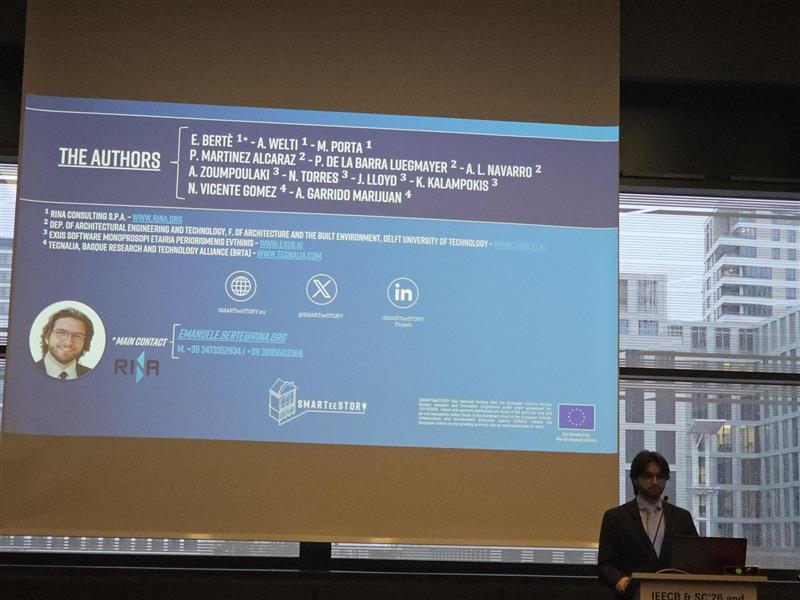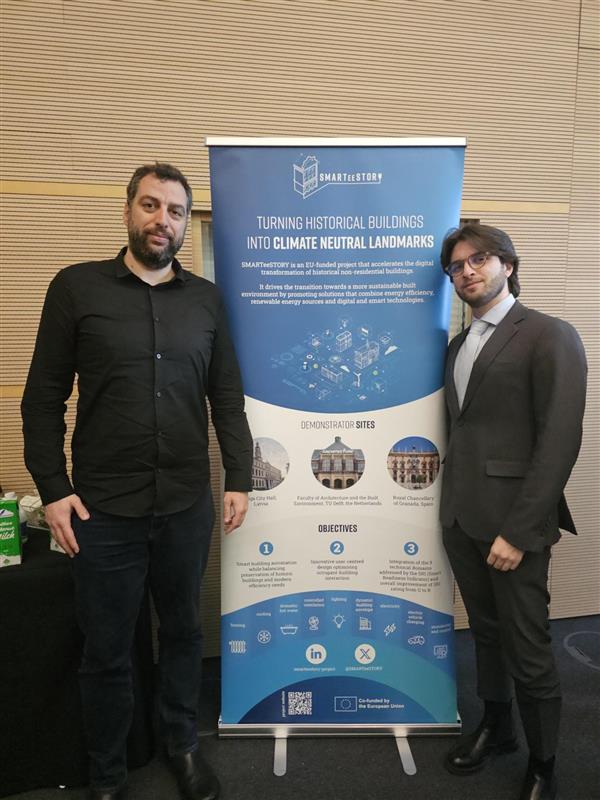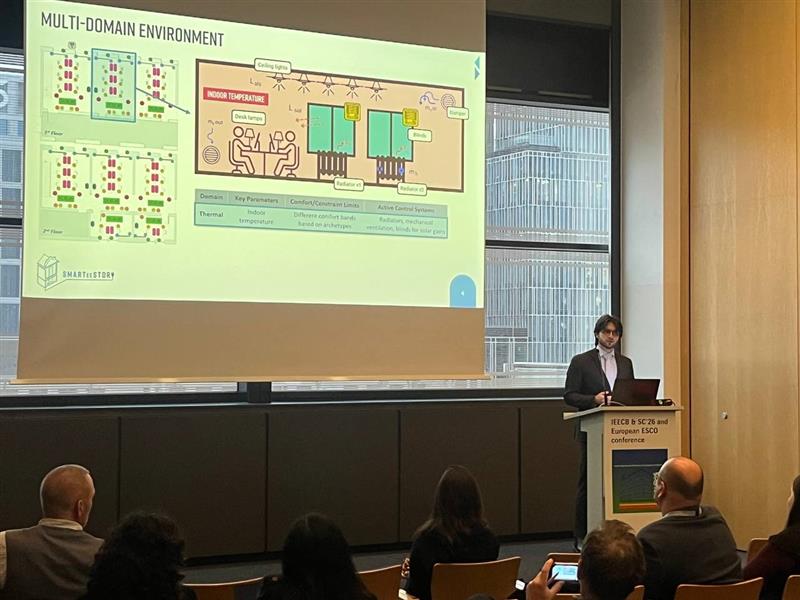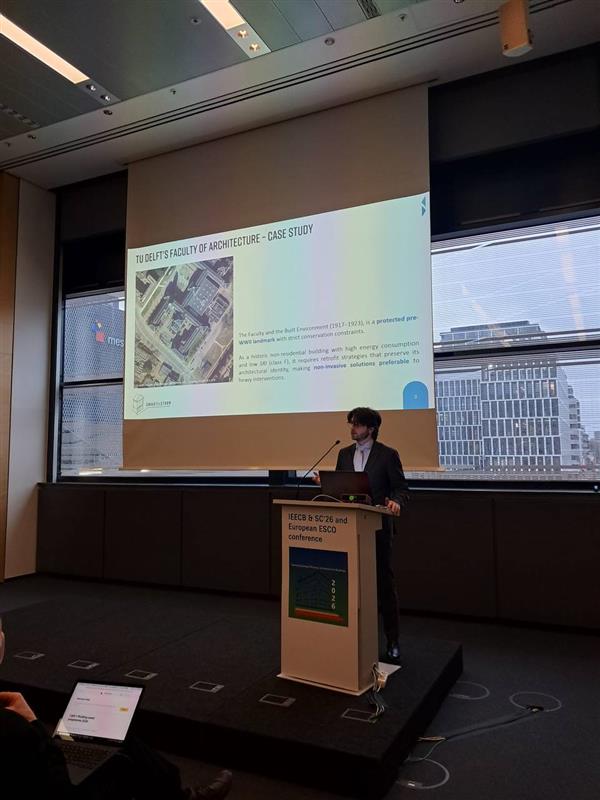

SMARTeeSTORY partner RINA has presented promising new research at the 13th International Conference on Improving Energy Efficiency in Commercial Buildings and Smart Communities (IEECB&SC’26), demonstrating how advanced control strategies can significantly improve the performance of heritage office buildings.
Nearly 23% of the European building stock dates back to before World War II, while renovation rates remain below 1% per year. These buildings are often subject to architectural constraints, such as protected façades and windows, that limit traditional retrofit options. As a result, the most effective lever for reducing energy consumption lies in the way existing systems are operated, including heating, ventilation, lighting, and shading.
Conventional building management systems are still largely based on simple rule-based logic (e.g., “if temperature falls below a threshold, switch heating on”). While straightforward, this approach struggles to handle the complexity of large buildings with diverse occupancy patterns, varying comfort requirements, and multiple interacting systems.
To address these limitations, SMARTeeSTORY partners investigated a multi-domain Model Predictive Control (MPC) approach. Unlike reactive control strategies, MPC is a method that anticipates future conditions, such as weather and occupancy, and continuously optimises system operation to minimise energy use and costs while maintaining indoor comfort and air quality within defined targets.
Half the energy, full comfort
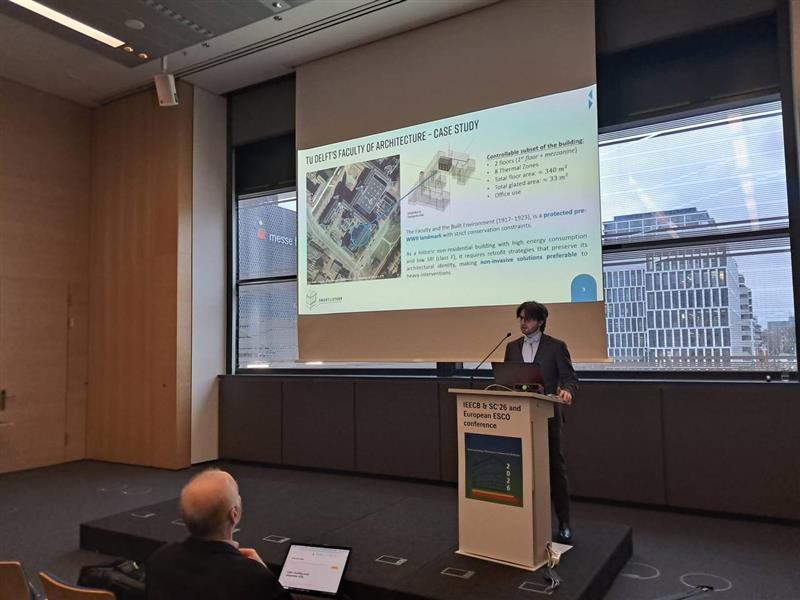
The approach was tested through a detailed simulation of the Faculty of Architecture at TU Delft, a large and complex historic building and one of the project’s demonstration sites. The model accounted for:
- 8 thermal zones within the building
- 3 thermal comfort archetypes representing different occupant preferences
- Multiple dimensions of indoor environmental quality, including thermal comfort, air quality (CO₂, humidity, particulate matter), and visual comfort
The MPC strategy was benchmarked against a conventional rule-based controller using the same building model and system configuration. Both approaches were evaluated over a 24-hour period with 15-minute time steps under varying occupancy scenarios.
Compared to the rule-based approach, MPC delivered substantial improvements:
- Approximately 50% reduction in thermal energy consumption, corresponding to about 148 kWh/m²/year of primary energy savings over the heating season
- Operating costs were reduced from around €55/day to €27/day
- Full compliance with thermal comfort requirements during occupied hours
- Effective control of particulate matter and strong visual comfort performance, supported by a daylight-first strategy for lighting and shading
Additionally, MPC demonstrated advanced operational behaviours that rule-based systems cannot replicate, including anticipatory preheating in the morning, intelligent trade-offs between ventilation and heat losses, and occupancy-aware temperature adjustments to operate near optimal comfort thresholds.
From simulations to real buildings
These results are based on physics-based simulations for a representative day and should be interpreted as indicative rather than definitive performance values.
The next phase of the project will focus on refining the simulation framework and validating results using more detailed and consistent models. Partners also plan to integrate machine learning techniques to improve short-term heating demand forecasts and progressively deploy the control strategy in the real building.
A digital path for heritage buildings
The findings highlight a key insight: when physical retrofit options are limited, digital solutions can play a transformative role. Predictive control can effectively act as a “virtual retrofit”, saving energy and cost while preserving occupant comfort and respecting architectural constraints.
SMARTeeSTORY demonstrates that intelligent control is more than an incremental improvement. It is a practical and scalable strategy to improve the energy performance of Europe’s historic building stock.