
Digitalisation in Historic Buildings: Key Requirements and Performance Metrics
How can historic buildings and smart technology come together without compromising its cultural preservation?
Historic buildings present a big potential for digitalization as it improves comfort levels of the building users and lowers energy consumption. The nature of historic buildings and the obligation to its preservation, however, presents limitations for energy efficiency interventions. This report defines the criterias that need to be fulfilled to digitalize historic buildings, while taking into account the needs of its users and requirements for cultural preservation.
In this aim, this report consists of three main sections:
Requirements of digitalisation and the relevant local regulatory framework
The different types of protection that apply to historic buildings were reviewed against the historical and digitalisation regulations and policies that apply to each example. This was then used to decide on a way to improve the energy efficiency of such cultural buildings. The results also look at the best ways to make old buildings more energy efficient and use digital technology, and explain the most important things to consider when preserving historical buildings as part of the SMARTeeSTORY project.
Digital tools can help historic buildings become more efficient without compromising their character and cultural value.
Characterisation of user needs
A number of different approaches were used to get the people who use the building involved in the porcess (the end users, the operators, the energy manager, the facility manager and the owners). This was done to find out what they needed in terms of wellbeing and ways to improve the a historical building using technology. This was an important step in understanding the problems users had, how they used smart services, and what they expected.
Identification of Key Performance Indicators (KPI) to measure improvements of digitalization
Five categories of impact criteria were chosen, such as economic, environmental, energy, and user-related performances of the building. The identified KPIs will then allow the tracking of the buildings performance by measurement of these impact criteria as the smart-readiness level of the building improves throughout the project, due to the interventions.
The results of this report guides the technical implementations of the energy retrofitting and 'smartification' measures carried out in SMARTeeSTORY's demo sites.
Recording now available for our webinar, "Can Every Building be Smart?" !
The webinar took place on the 27th of May 2025 as part of EUSEW 2025 - Sustainable Energy Days. Moderator Matteo Porta, from RINA Consulting, took us through the session starting with an introduction of all our speakers, an interactive survey addressing the participants, and the expert insights session followed by a short Q&A.
Hosted by the EU-funded Horizon projects SMARTeeSTORY and BuildOn, this session offered insights, and explored innovative approaches to align building energy performance with the EU's decarbonisation objectives. SMARTeeSTORY, a pioneer in applying the SRI in real-world scenarios of historical buildings, and BuildOn, focusing on cost-effective automation solutions, showcased best practices, technological advancements, and policy integration strategies. Guest project REN+HOMES also contributed to the discussion by highlighting their methodologies and recommendations for positive energy buildings. The session emphasized how leveraging digital solutions and user engagement can improve energy performance across diverse building types, in line with the EU's goals set out in the EPBD.
This event is part of the EUSEW 2025 - Sustainable Energy Days. Find out more about the European Sustainable Energy Week: EUSEW Interactive
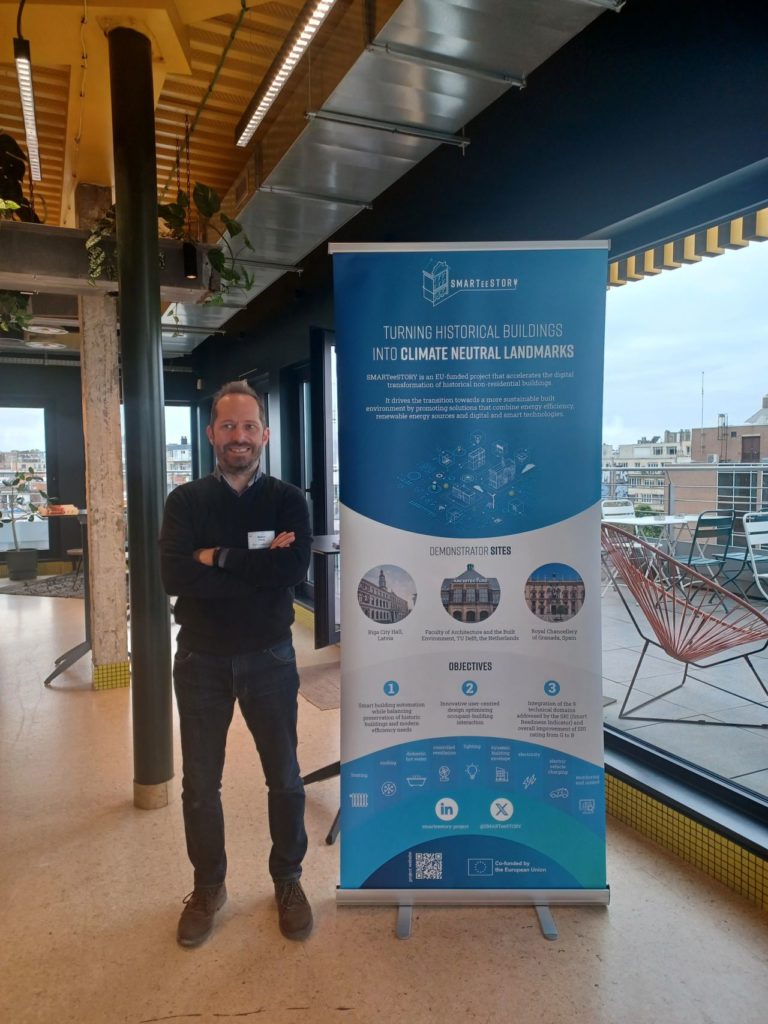
SMARTeeSTORY was featured at the 3rdSRI Joint Event and Final Conference of the SRI-ENACT project, where project coordinator Matteo Porta presented the latest updates and insights from the project.
Organised by the European Commission's DG ENER, CINEA, and SRI-ENACT in collaboration with the LIFE CET SRI Cluster, including SRI2MARKET, EasySRI, and SMART2, the hybrid event brought together over 80 in-person participants and many more online, including policymakers, industry leaders, and sustainability experts.
Advancing SRI in historic buildings
As one of the first projects applying the Smart Readiness Indicator (SRI) to historical buildings, SMARTeeSTORY highlighted its practical approach and key developments across its three demo sites:
- The Riga City Hall in Latvia
- The Faculty of Architecture at TU Delft in the Netherlands
- The Royal Chancellery of Granada in Spain
Matteo Porta also mentioned the SMARTeeSTORY SRI Web Tool, developed by TECNALIA and RINA, which enables users to simulate SRI assessments and explore potential energy performance improvements.
Final milestone for SRI-ENACT
The event also marked the conclusion of the SRI-ENACT project, showcasing results from pilot implementations across eight countries: Greece, Romania, Bulgaria, Croatia, Latvia, Spain, Czech Republic, and Austria. Project partners shared data, lessons learned, and strategies for scaling up the use of SRI throughout Europe.
SMARTeeSTORY is proud to announce the joining with the Smart Energy Cluster, an initiative of the InEExS LIFE project. This strategic partnership aims to create a unified front for EU projects focused on smart energy solutions, merging various energy services and incorporating non-energy benefits to overcome market fragmentation and foster cooperation.
Key Objectives of the SmartEnergyCluster:
- Exchange & Engagement: Prioritizing the exchange of knowledge and engaging stakeholders through shared communication efforts to foster a collaborative network.
- Combined Expertise: Leveraging collective experience and active participation to elevate the promotion of innovative projects.
- Strategic Development: Defining a cohesive strategy that includes cross-promotion and joint events to enhance collaborative impact.
For SMARTeeSTORY, this partnership means amplifying the reach and impact of its solutions, fostering awareness and acceptance of smart energy solutions in historical buildings, and teaming up with other experts to advance its mission.
Explore the Smart Energy Cluster: https://smartenergycluster.eu/home
Stay up-to-date with the cluster on LinkedIn 👉 #SmartEnergyCluster
During SMARTeeSTORY's last General Assembly, the consortium was trained on a very important part of our work in the project: the users. The project's user centricity experts, our colleagues from TU Delft, presented the theoretical background and workshop on the topic.
The human-building interaction is an important factor to consider in the design of automated and smart buildings. The comfort level of the user, their acceptance of the new technology and materials, and their interaction with the smart building control system all determine the success of an automation system and the satisfaction they bring to the user.
The training started with an introduction to human-building interactions and how they can be optimised for user satisfaction while maximising the energy efficiency of the system. It was followed by an explanation of the user archetypes, or the grouping of users based on individual thermal preferences. The final part of the presentation described the design of effective user control for optimum human-building interaction. including placement of devices and the ease of use, and the availability of information at the interface of the controls.
Following the presentation was a short workshop session where the participants were surveyed on their preferences on how building controls would be displayed, including, among others, the system status, override controls, giving feedback, and alerts on low environmental quality.
Takeaways:
- Building automation is often disruptive to occupants, so a higher degree of acceptance and wellbeing can be achieved through returning the sense of personal control and enabling overrides by the user.
- The indoor comfort quality is a multi-domain problem that involves multiple factors such as noise, view, glare, daylight, and personal control.
- In SMARTeeSTORY, the user archetypes will be determined based on the preferences recorded in the monitoring data from the occupants, which will later on be fed into the system.
- An optimum user control interface for smart buildings involves a balance of i) the amount and type of information displayed, ii) the position of the devices, and iii) the type of device used for control (e.g., digital or analog)
On April 9th-10th, SMARTeeSTORY gathered in the Stuttgart, Germany for the 5th General Assembly. New goals were defined, current activities explained, and obstacles faced were presented to the consortium for solutions.
As installations of devices continued in each of the three demo sites, particular next steps were set out in anticipation of the upcoming start of the monitoring campaign. For example, procurement of photovoltaics and installation plans were finalized and necessary power components were defined.
As results from the project beginto slowly take shape, it becomes important to characterise each result and identify their potentials for further use beyond the project. Such intellectual property management activities are key in taking stock of the outputs of the project and ensuring their lasting impact beyond the end of the project.
On the second day, the consortium received an internal training on the topic of User Centricity, given by the project's experts in user interaction, TU Delft. Along with the theoretical background of user satisfaction and the interactions with smart building systems, they also shared a survey to determine the best user interface for such systems. The feedback and comments from the consortium served as a basis to further developing the user interface systems, coming from a knowledgeable and expert audience group specializing in the field of smart technology.
We cherish the in-person meetings and the chance to exchange and discuss extensively and collectively as it is the best way to solve problems faced in the project. The consortium left the meeting energized and inspired from the interactions had, ready to work and progress in the coming months. A huge thank you was directed at Steinbeis Europa Zentrum for hosting the meeting at their offices.
In an effort to advance building digitalisation and energy efficiency, SMARTeeSTORY gathered for an internal training session on the Smart Readiness Indicator (SRI), a key tool introduced by the European Union's Energy Performance of Buildings Directive (EPBD). The session, led by TECNALIA and RINA during the recent General Assembly, focused on the SRI framework, its benefits, and practical applications.
The SRI is designed to assess buildings' ability to optimise energy use, enhance occupant comfort, and interact with the energy grid. The training session provided an in-depth understanding of its methodology, which evaluates nine key domains, including heating, cooling, ventilation, and electric vehicle charging. With functionality levels ranging from basic to fully automated, the SRI aims to encourage smarter energy management in buildings.
Despite its voluntary adoption, the SRI presents new opportunities for early adopters, including improved building efficiency, cost savings, and sustainability benefits.
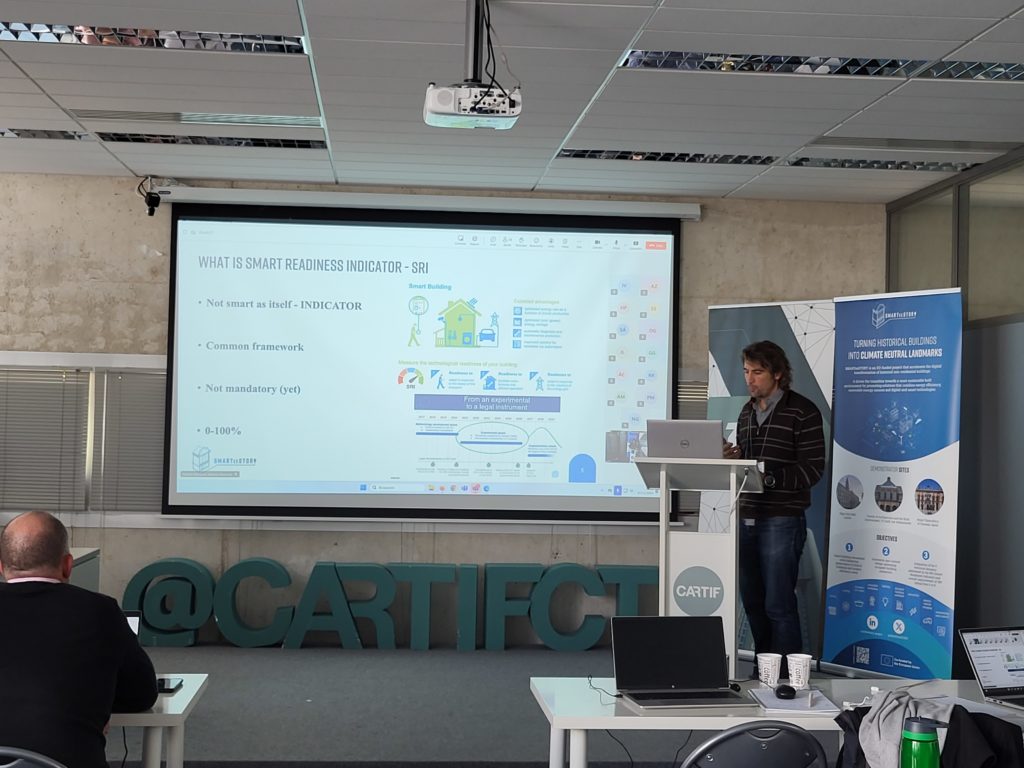
A key highlight of the training session was the demonstration SMARTeeSTORY SRI Web Tool, developed by TECNALIA, which allows users to simulate SRI calculations. Participants engaged in hands-on exercises, applying the tool to assess a hospital case study, analysing its heating, cooling, and energy efficiency performance. Attendees also shared valuable insights and feedback, contributing to further enhancements of the tool.
Stay tuned—the SMARTeeSTORY SRI Web Tool will soon be available to the public, bringing the power of smart building assessment to a wider audience!
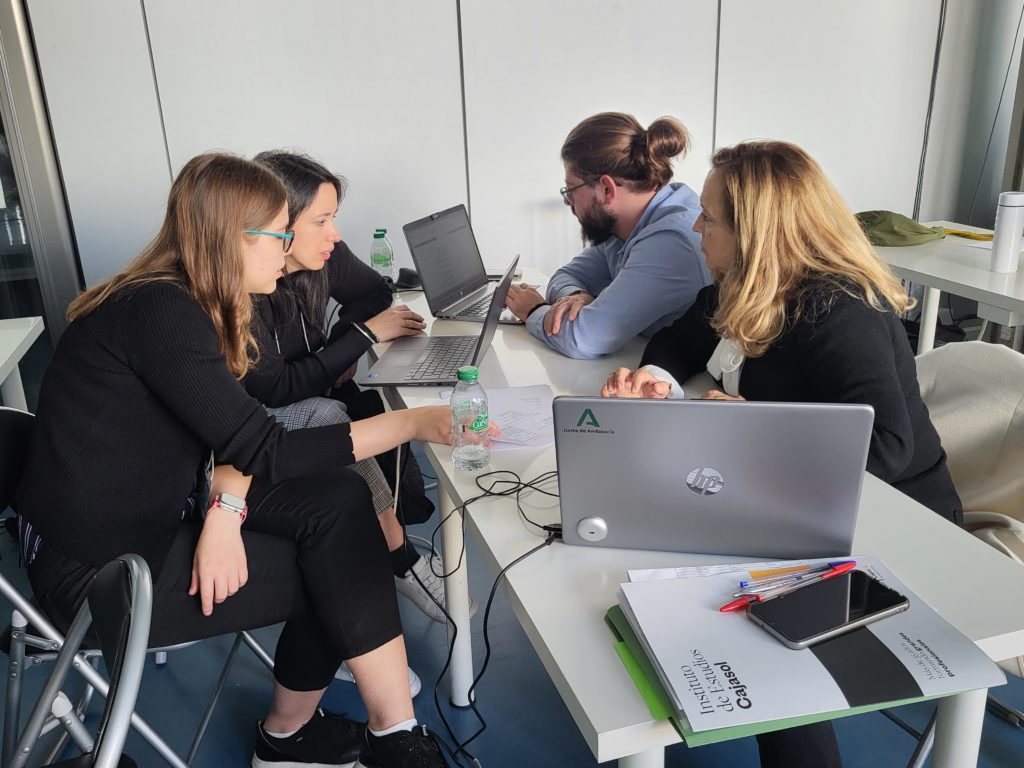
Last week, SMARTeeSTORY partners came together for our first review meeting, joined by our project officer, Juan Carlos Espada Suarez. This milestone provided an opportunity to reflect on the first 18 months of the project—and the progress has been remarkable!
A Look at Our Achievements
Over the past year and a half, we were able to fully identify the SMARTeeSTORY requirements and make advancements at our three demo sites, where our vision is coming to life:
- Riga City Hall, Latvia
- Faculty of Architecture at TU Delft, Netherlands
- Royal Chancellery in Granada, Spain
Each of these historic landmarks serves as a testing ground for innovative solutions aimed at enhancing energy efficiency while preserving cultural heritage. While there is still plenty of work ahead, we are on the right track to transforming historic buildings into climate-neutral landmarks.
In this first period we have:
- Assessed the SMARTeeSTORY chosen technological solutions from our provider partners TERA, Pellini, and Schneider Electric
- Described SMARTeeSTORY's software platform architecture
- Identified requirements for digitalization on historic buildings
The upcoming months will be crucial in continuing SMARTeeSTORY's work! Our partners are working hard on our demo sites to install devices which are central to the monitoring of performance, energy efficiency, and user comfort before and after the interventions.
The SMARTeeSTORY Vision
At the heart of SMARTeeSTORY is the ambition to develop a smart, integrated building automation and control system designed specifically for historic non-residential buildings. Our innovative multi-domain approach—aligned with the Smart Readiness Indicator (SRI) methodology—takes into account:
- The unique challenges of historic buildings
- Human-centric design for enhanced user experience
- Real-time monitoring and active user engagement
By integrating these elements, SMARTeeSTORY is paving the way for smarter, more sustainable historic buildings, balancing technological advancements with heritage conservation. With strong collaboration among our partners, we are making steady progress toward a future where historic buildings are not just preserved but optimised for energy efficiency and sustainability.
SMARTeeSTORY's project report D1.5 presents the SRI-based assessment tool for historic buildings of the SMARTeeSTORY project.
The Smart Readiness Indicator (SRI) methodology allows for qualitative and quantitative assessment of the state of the building's capacities and preparation to incorporate smart services around three pillars: energy performance over time, ability to adapt to the needs of the occupants and contribution to the stability of energy grids through active demand management. Implementation of the SRI aims to increase awareness about the benefits of smart building technologies, e.g.: automated systems and electronic monitoring for different building technical systems (heating, hot water, ventilation, lighting, etc.). In fact, the adoption of the SRI framework will foster innovation in the construction industry by encouraging the use of advanced smart technologies in buildings.
The report summarizes the creation of a webApp to simplify the calculation of the SRI, following the detailed calculation included in Method B – Expert SRI assessment according to the European Commission. The document describes the current version of the webApp, its structure, main sections, and current functionalities. The webApp allows users to upload specific building information to assess the SRI of any specific building. The assessment is carried out on a user-friendly environment and supported by a virtual assistant. This early version of the webApp will be the basis for the second stage, which will include new functionalities as an added value to the current SRI assessment process.
Check back soon to access the report once its published!
At Sustainable Places 2024, SMARTeeSTORY took part in the Regeneration Workshop:
Crafting Sustainable and Inclusive Neighbourhoods
Hosted by the REGEN project, the workshop showcases B4P projects funded under the HORIZON-CL5-2022-D4-02-02 call (Solutions for the sustainable, resilient, inclusive and accessible regeneration of neighbourhoods enabling low carbon footprint lifestyles and businesses). The workshop aims to encourage collaboration among B4P stakeholders to create an inclusive, positive built environment. The workshop will focus on neighborhood regeneration towards sustainable, inclusive, and low-carbon environments, focusing on innovation actions in buildings and urban environments. The workshop will be promoted among ECTP and WorldGBC members, supporting the REGEN project
Projects in this session: REGEN - CALECHE - drop - EVELIXIA - Inherit - REHOUSE - SNUG - WeGenerate - NBenefit$ 3.0 - SMARTeeSTORY - GreenPass
Learn more about the Built4People Partnership
Catch the workshop replay below!
See original source: Sustainable and Inclusive Neighbourhood Regeneration - Sustainable Places (SP)
Check out the highlight from Sustainable Places 2024: Sustainable Places 2024 - Highlights
Subscribe to our newsletter