
SMARTeeSTORY at the Conference on Cultural Heritage and New Technologies (CHNT31)
SMARTeeSTORY Training Session at CHNT31 - Smartness of Historical Buildings: Approaches and lessons learnt from a real application
Learn how energy efficiency and building smartness can be achieved through the SRI methodology application in SMARTeeSTORY’s three historical buildings.
11 November 2026, 10:20-12:20 CEST | Vienna, Austria
Description
This training session adopts a practical and interactive approach based on the real experience of the SMARTeeSTORY Horizon Europe project. The session begins with a brief introduction of the trainers and an overview of the SMARTeeSTORY project, followed by a structured training programme.
First, participants will receive an introduction to the Smart Readiness Indicator (SRI) methodology, including its definition, scope, and areas of application. The training will then address the complexity of renovating historic buildings and improving their operational efficiency while respecting heritage values.
The relationship between energy efficiency potential and building smartness will be explored through the application of the SRI methodology. The SMARTeeSTORY project will be presented as a case example, highlighting its objectives, challenges encountered during implementation, and the solutions developed.
The core of the training will focus on case studies from the project that demonstrate practical applications of SRI in historic contexts. Trainers will present examples where smart technologies were successfully integrated into historic buildings, discussing technical, regulatory, and cultural challenges encountered. Particular emphasis will be placed on lessons learned, including stakeholder engagement, adaptability of smart technologies to heritage constraints, and measurable benefits in terms of decarbonisation and operational efficiency.
Interactive elements such as group discussions, exercises using SRI tools, and question-and-answer sessions will allow participants to reflect on the presented approaches and apply them to their own contexts. Participants will also receive practical guidance on conducting SRI assessments, interpreting results, and planning smart upgrades that respect both the historical value and the technological potential of heritage buildings.
By the end of the training, participants will gain a comprehensive understanding of how SRI can be applied to historic buildings and will leave with actionable strategies and professional connections to support future implementation.
Meet the Trainers
Antonio GARRIDO MARIJUAN, Tecnalia, Spain
Alessandra Luna NAVARRO, TU Delft, Italy
Andrea NATALE, Schneider Electric, Italy
Motivation
The training aims to address barriers to the renovation of historic buildings by demonstrating how automation of Technical Building Systems (TBS) and the application of the Smart Readiness Indicator (SRI) can increase building smartness while supporting decarbonisation goals.
Who you are
Building managers; municipal administrators and decision-makers; technology providers; designers; technicians.
Keywords
Smartness; SRI; historic buildings; advanced controls; decarbonisation
About CHNT31
Getting Dirty – Back to the Roots of Cultural Heritage Work
Heritage in Action: From the Field to the Future
This year's CHNT happens from the 11-13 November 2026 in the beautiful Schönnbrunn Palace in Vienna, Austria. ultural heritage is understood most clearly when encountered in the places where it originates: in the field, within historic structures, and across landscapes shaped by human activity.CHNT31 holistically addresses the diverse actors that shape the heritage field—researchers, digital specialists, practitioners, managers, and those who often combine several of these roles.
Please register for the trainings by E-mail to: info@chnt.at
Subject: Registration Training "Smartness of historical buildings")
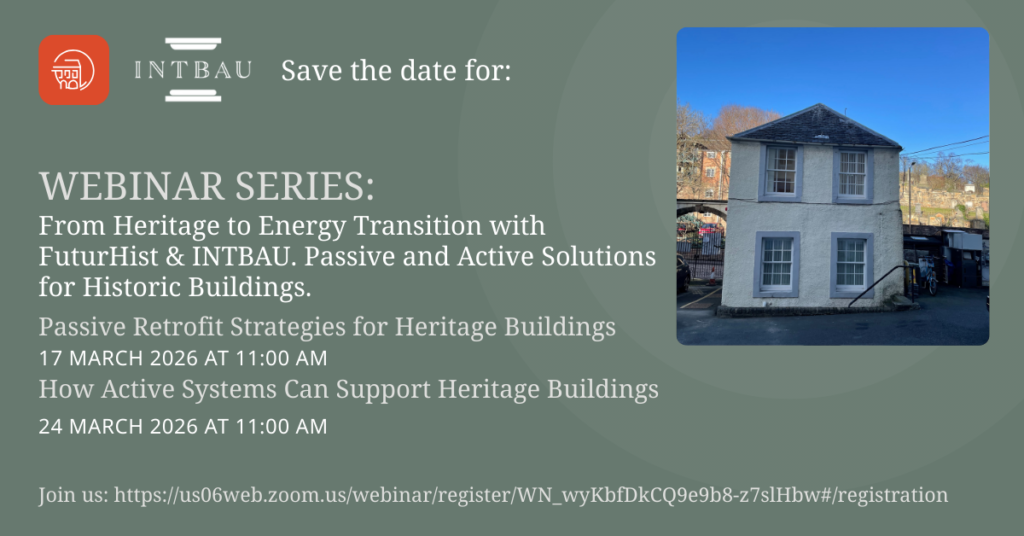
Join the new webinars jointly developed by FuturHist and INTBAU – “From Heritage to Energy Transition with FuturHist & INTBAU. Passive and Active Solutions for Historic Buildings”.
- “Passive Retrofit Strategies for Heritage Buildings”, March 17, 2026, 11:00 AM – 12.30 PM CET.
During the webinar, we will explore examples of passive solutions in historic buildings, focusing on insulation systems and window solutions. Our experts Marianna Muchorowska (Innsbruck University) and Alexandra Troi (Eurac Research), will share their knowledge and experience gathered in the deliverable “Conservation compatible passive retrofit solutions”. - “How Active Systems Can Support Heritage Buildings” March 24, 2026, 11:00 AM – 12.30 PM CET. During this webinar, we will discuss active solutions with our experts Federico Trentin (Eurac Research) and Marianna Muchorowska (Innsbruck University). They will highlight the key learnings from the deliverable “Conservation compatible solutions for HVAC and RES integration in Historic Buildings“.
The sessions will be moderated by Tomasz Jeleński (The Sendzimir Foundation/INTBAU).
Sustainable Places 2026 is a ... over three days!
Don't miss our workshop,...
"..."
OO December 2026 | XX AM – XX PM CET
📍...
XXX
Enlit is a global forum dedicated to addressing all aspects of the energy transition. This year, Enlit Europe is taking place in Bilbao, a global energy hub where the members of the energy community will discuss the future of the energy sector over three days!
Don't miss our workshop, hosted by the Smart Energy Cluster:
"From Buildings to Communities: Innovation in Energy Efficiency and Grid Integration"
19 November 2025 | 11:30 AM – 13:00 PM CET
📍EU Projects Zone Hub - Theatre 1 (Hall 5)
The Smart Energy Cluster workshop at ENLIT Europe 2025 will showcase how Europe’s energy transition can be accelerated by linking smart building innovation with community-driven energy models and smart grid integration. Six EU-funded projects—ReSCHOOL, ENPOWER, CRETE VALLEY, SMARTeeSTORY, DEDALUS, and META BUILD—will present solutions for building renovation, energy efficiency and flexibility, and citizen participation in local energy markets. The sessions will highlight how digitalisation, advanced data integration, and innovative business models are reshaping sustainable energy across buildings and communities.
In this session, coordinator Matteo Porta will be representing SMARTeeSTORY, giving insights on Smart Control Systems and Energy Optimisation for Historic Non-Residential Buildings.
Find us at the EU Projects Zone!
IEECB & SC 2026 - The 13th International Conference on Improving Energy Efficiency in Commercial Buildings and Smart Communities will be organised in conjunction with the European ESCO Conference in Frankfurt (Germany). It aims to attract property owner, investors, architects, local authorities and urban planners to present and discuss synergies and cooperation in removing existing barriers to energy efficiency, renewable energy and smart buildings and districts.
11-12 March 2026
Frankurt, Germany
SMARTeeSTORY will be contributing to this conference with a submission on:
Multi-domain model predictive control for energy efficiency under different occupant demands in office buildings located in historical building
Emanuele Bertè 1*, Andrea Welti 1, Matteo Porta 1, Pablo Martinez Alcaraz 2, Pedro de la Barra Luegmayer 2, Alessandra Luna Navarro 2, Alexia Zoumpoulaki 3, Nahime Torres 3, James Lloyd 3, Konstantinos Kalampokis 3, Noelia Vicente Gómez 4, Antonio Garrido Marijuan 4
1 RINA CONSULTING S.P.A.
2 Department of Architectural Engineering and Technology, Faculty of Architecture and the Built Environment, Delft University of Technology
3 EXUS SOFTWARE MONOPROSOPI ETAIRIA PERIORISMENIS EVTHINIS
4 TECNALIA, Basque Research and Technology Alliance (BRTA)
Life. Spaces. Buildings. The Festival of the New European Bauhaus is back!
The European Commission organises the third edition of the New European Bauhaus Festival in Brussels (Belgium) on 9-13 June 2026, and you can be part of it!
The NEB Festival 2026 will, among other topics, address the transformative power of democratic engagement in shaping more inclusive and sustainable communities. It will highlight how empowered citizens and local authorities can play an active role in creating their environments, with a particular emphasis on affordable housing as a cornerstone of democratic participation. In line with the NEB’s core vision, the Festival will be a space to reimagine our built environment, placing first life, then spaces, and then buildings.
The Festival encompasses four key pillars:
Satellite events - initiatives and events organised independently in Brussels and beyond, aligned with the New European Bauhaus values.
Forum - a platform for engaging discussions and the exchange of ideas surrounding the New European Bauhaus.
Fair - a laboratory and exhibition, highlighting projects and prototypes that align with and support the core values of the New European Bauhaus.
Fest - a celebration that unites culture, art, and conviviality, serving as a moment of collective rejoicing, honouring freedom of expression and embracing radical, innovative, and disruptive ideas and visions.
Buildings for the climate of the future: the key role of the HVAC sector.
Subscribe to our newsletter